How Many Sports Bras Do You Actually Need?
Quick Answer: For most people the practical number is four to six: two for your primary activity at the right support level, one or two lower-support options for everyday and low-impact wear, and one spare so you are never forced to wear a damp one. The bigger issue is usually distribution — most people own five bras at the same support level and none at the level their hardest workout requires.
The answer people expect is a single number. The useful answer is a small structure, because the bra that works for a Sunday walk is not doing anything for a Tuesday run.
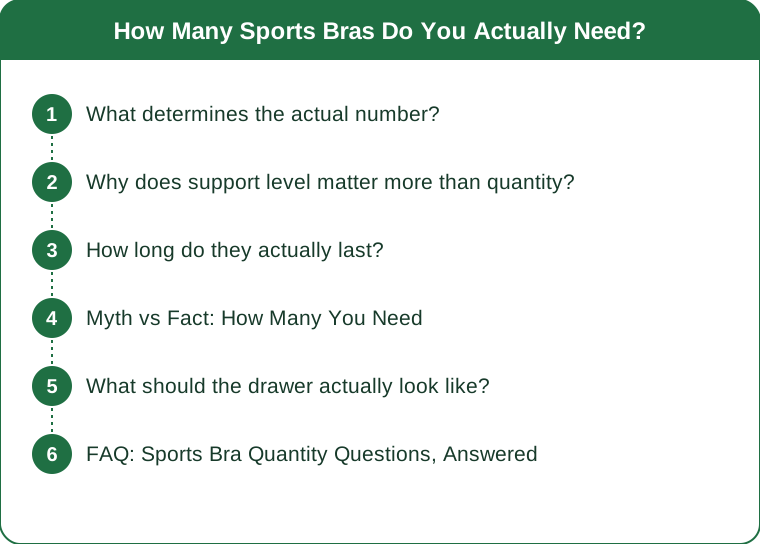
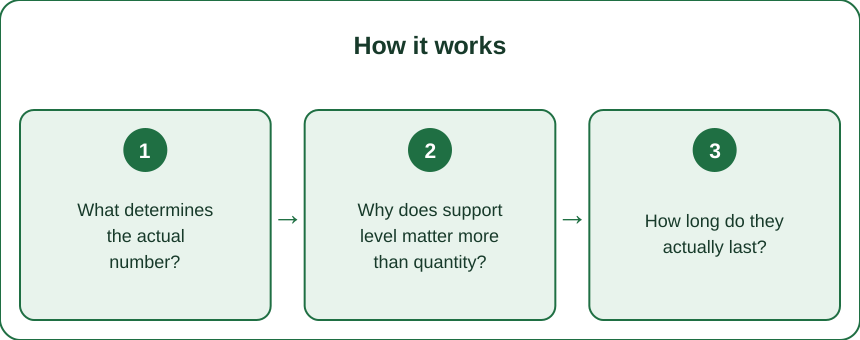
What determines the actual number?
Three inputs, and they multiply rather than add.
How often you train. Each bra needs a full drying cycle between wears — sports bras take considerably longer to dry than most activewear because of the layered construction, padding, and elastic, often 12 to 24 hours air-drying. Training four times a week with two bras means wearing damp ones, which degrades the elastic faster and is a reliable route to skin irritation.
How many distinct support levels you need. This is the part people miss. A high-impact running bra and a low-impact yoga bra are different products, and owning three of one does not cover the other.
Your laundry rhythm. Someone who washes twice a week needs more than someone who washes daily. Work backwards from this honestly rather than from an ideal.
The formula that works: for each activity type, take the number of sessions between laundry loads and add one. Then add one or two everyday low-support bras.
Worked example: you run three times a week, do two strength sessions, and do laundry weekly. That is three high-impact plus one spare, and two medium-support plus one — but the strength bras can double for other things, so realistically four high-impact and two medium, plus a couple of everyday options. Six to eight total, of which only four are doing serious work.
Why does support level matter more than quantity?
Because the wrong support level is not a compromise, it is a different garment.
Breast tissue is supported by skin and by Cooper’s ligaments, neither of which is elastic in a recoverable way. Once stretched, they do not return. During running, unsupported breast movement is substantial and multidirectional, and a bra that does not control it is not simply less comfortable — it is failing at the actual job.
The levels, honestly described:
- Low support: yoga, stretching, walking, lounging. Usually a simple pullover with light compression. Comfortable, easy to wash, dries fast.
- Medium support: strength training, cycling, elliptical, hiking. More structure, often a wider band, sometimes adjustable.
- High support: running, HIIT, jumping, court sports. Encapsulation or a serious compression build, wide band, wide straps, often adjustable and often with hooks.
The most common wardrobe mistake: five low-support pullovers and one aging high-impact bra, worn for everything. The pullovers are comfortable and cheap and they accumulate. Then the running bra wears out and does not get replaced because there are five bras in the drawer.
The band does the work, not the cups. Roughly 80% of the support in any bra comes from a firm band around your ribcage. If you are buying one good bra, buy the one with the best band fit, regardless of what the cups look like.
How long do they actually last?
Six to twelve months of regular use, and they fail invisibly.
The elastic is the part that dies, and it does so gradually enough that you adapt to it. A bra that has lost 30% of its support does not look any different — you simply find yourself adjusting more and noticing more movement, and you attribute both to something else.
Rough lifespan by use: a high-impact bra worn twice a week is usually done in about a year. Worn four times a week, closer to six months. Frequency of washing and drying matters as much as wearing.
The replacement signals:
- You are fastening it on a tighter hook than you used to. This is the clearest single indicator — the band has stretched.
- The band rides up during a workout. A functioning band stays level all the way around.
- You notice more movement than you remember.
- The fabric looks fine but feels slack when you stretch the band between your hands. Compare against a new one and the difference is obvious.
What kills them fastest: heat. A tumble dryer destroys elastane rapidly, and so does hot water. Fabric softener coats the fibers and reduces both wicking and elasticity. Wringing them out damages the structure.
What extends them: cold wash, in a mesh bag, hung to dry, and rotated so no single bra takes every session. Rotation genuinely extends life because elastic recovers over 24 hours out of use — the same reason shoe rotation works.
Myth vs Fact: How Many You Need
Myth: You should have one bra per workout day. Fact: You need one per workout between laundry loads, plus a buffer. Someone who washes every other day genuinely manages with fewer. The constraint is drying time, not training frequency.
Myth: Expensive bras last proportionally longer. Fact: Better construction does last longer, and not proportionally to price. The elastane degrades on a similar timeline regardless of what you paid. A well-cared-for mid-range bra outlasts a badly-cared-for expensive one comfortably.
Myth: You can wear a high-support bra for everything. Fact: You can, and it is unnecessarily restrictive for low-impact activity, which makes people stop wearing it and reach for something comfortable instead. It also wears out your best bra on days that did not require it.
Myth: One size fits all activities. Fact: Many people are between sizes and want a slightly firmer fit for running and a slightly looser one for yoga. Buying the same size across support levels is not required and often not ideal.
Myth: Sports bras should be uncomfortably tight to work. Fact: Firm, not painful. If you have red marks that persist for more than a few minutes, restricted breathing, or shoulder pain from the straps, it is too small or the wrong style — and an overly tight bra does not provide more support, it just distributes pressure badly.
What should the drawer actually look like?
A working set for most people, adjustable to your activities.
The core four to six:
- Two high-support bras if you run, jump, or play court sports. These are the ones worth spending money on and replacing on schedule.
- Two medium-support bras for strength work, cycling, and hiking. These get the most total wear for most people.
- One or two low-support for yoga, walking, travel, and days off.
Add one seasonal consideration: as training moves indoors this autumn, most people sweat more per session than they did outdoors in a breeze, and a bra that dried overnight in August may not dry overnight in a closed-up October house. If your drying time goes up, your required count goes up with it — this is the specific reason people run short in the fall without understanding why.
The audit worth doing right now, and it takes ten minutes:
- Take them all out. Stretch each band between your hands.
- Anything slack, anything you fasten tighter than you used to, anything you avoid wearing — retire it.
- Count what remains by support level, not by total.
- Buy for the gap, which is almost always at the high-support end.
And the practical rule that prevents the whole problem: when you buy a new high-support bra, buy it before the old one is dead, not after. The gap between a bra failing and being replaced is where people train in inadequate support for two months, and that is the part that actually matters.
FAQ: Sports Bra Quantity Questions, Answered
Can I wear a sports bra twice before washing?
Better not to if you sweated in it. Sweat degrades elastane over time and bacteria in the fabric cause both odor and skin irritation, particularly under a band. If it was a light session, air it out completely and wear it once more; anything sweaty should go straight in the wash.
Is it worth buying the same bra in multiples once I find one that fits?
Yes, and it is one of the genuinely good pieces of activewear advice. Fit is the hard part and models get discontinued constantly. If one works properly for your primary activity, buying two more is a reasonable move — just stagger the wear so they do not all fail in the same month.
Do I need a different bra for indoor versus outdoor training?
Not for support, which depends on the activity rather than the venue. Fabric weight is worth thinking about though — indoor training generates more sweat with less airflow, so a lighter, more breathable bra is often more comfortable indoors even for the same workout.
TL;DR:
- Four to six is the working number for most people, driven by drying time rather than training days
- Distribution matters more than count: two high-support, two medium, one or two low
- The band provides roughly 80% of the support — buy for band fit above everything else
- Replace when you are fastening a tighter hook or the band rides up, usually six to twelve months
- Cold wash, mesh bag, hang to dry, and rotate so elastic can recover
Most drawers are not short on bras. They are short on the one bra that the hardest workout of the week actually requires, and long on the comfortable ones that accumulated on their own.
See It in Motion
Seen here: UPF 50+ Short Sleeve Rashguard Swim Shirt — shop it on bubblelime.com
Keep Reading
This article is for general informational and styling purposes only. Fit, sizing, and product availability may vary.