Why Your Sports Bra Stops Supporting Before It Looks Worn Out
Quick Answer: Support comes from elastane in the band, and elastane degrades from heat, body oils, chlorine, and repeated maximum stretch long before the outer fabric shows any wear. Most sports bras lose meaningful support at somewhere between 30 and 40 hard sessions, or roughly six to twelve months of regular use, while still looking new.
The bra looks fine. No pilling, no holes, colour still good.
And yet the run felt different, and you have been quietly reaching for a different one for weeks without deciding to.
That is not fussiness. The component doing the work has degraded, and it is not a component you can see.

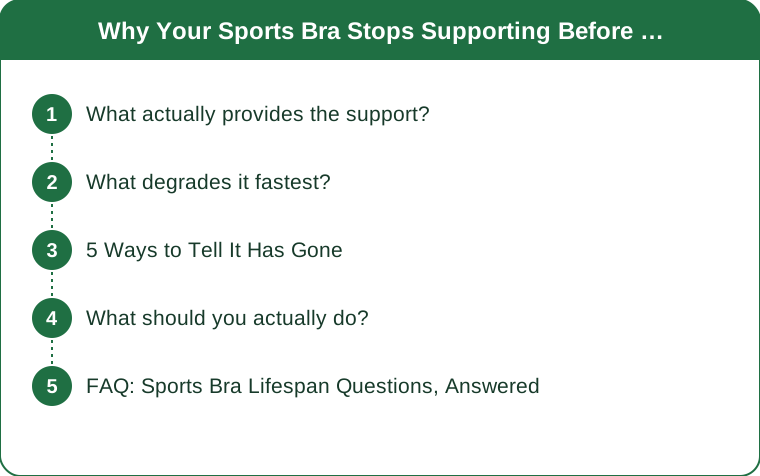
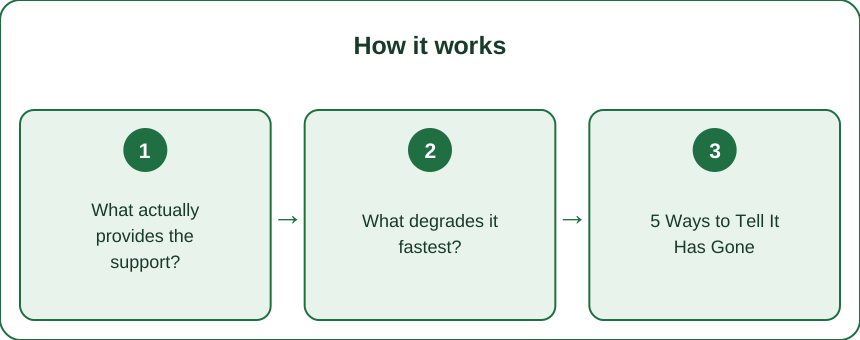
What actually provides the support?
The band. Almost all of it.
A well-fitting sports bra takes something in the region of 80 percent of its support from the band around your ribcage, with the straps and cups contributing the remainder. That is why band size matters more than cup size, and it is also why band failure is the whole story here.
The band works by elastic tension. Elastane fibres - Lycra, spandex, however it is labelled - are stretched slightly at rest and pull back continuously. That constant, even tension is what holds the band against your ribs so it can act as an anchor.
Elastane is a polymer, and polymers degrade. The molecular chains that give it its recoil break down over time and with exposure, and once they break they do not reform. The fibre gets longer at rest and pulls back with less force.
Crucially, the nylon or polyester that makes up most of the fabric does not degrade at anything like the same rate. So the visible part of the garment - the surface you look at to judge its condition - stays intact for years while the functional part quietly gives up.
That mismatch is why sports bras get replaced far later than they should.
What degrades it fastest?
In rough order of damage caused.
Heat. Tumble dryers are the single worst thing you can do to elastane, and hot washes are second. Heat accelerates polymer breakdown directly, and a few dryer cycles can cost more elastic life than months of wear. Bras dried on a radiator are in the same category.
Body oils and sweat residue. Skin oils penetrate elastane and break it down from within. This is why a bra worn twice between washes deteriorates faster than one washed after each use, and why the smell problem and the support problem tend to arrive together - both come from residue that ordinary washing has not removed.
Chlorine and hard water minerals. Devastating to elastane. A bra used for swimming has a much shorter life, and even chlorinated tap water in some areas contributes.
Repeated maximum stretch. Pulling a bra on over your head, particularly a tight compression style, stretches the band well past its working range. Doing that twice a day for a year is a lot of cycles at the top of the fibre’s range, which is where the damage happens.
Fabric softener. Coats the fibres, reduces both wicking and recovery, and the effect is cumulative and permanent. It is the most commonly given piece of laundry advice and the worst one for activewear.

5 Ways to Tell It Has Gone
1. The band no longer leaves a light mark. A correctly tensioned band leaves a faint temporary impression on the skin after a session. When it stops doing that, it has stopped applying tension, and tension was the job.
2. You have moved to a tighter hook. Everyone does this gradually and almost nobody notices they have. Running out of hooks is the clearest single signal available - when you are on the tightest row and it still feels loose, the band is done.
3. You can pull the band far away from your body. Two fingers should be about the limit at the back. If you can get a whole hand under it comfortably, it is not anchoring anything.
4. It feels fine walking and wrong running. Degraded elastane still holds at low load and gives up under high load, so the failure shows up in exactly the situation the bra exists for. If it feels good in the changing room and inadequate at pace, that is the pattern.
5. You have started adjusting mid-session. Reaching to pull the band down or the straps up during a workout is a behaviour that appears without any conscious decision. If you catch yourself doing it, it started weeks ago.
What should you actually do?
Extend the life of the ones you have, and replace on a schedule rather than on appearance.
Rotate at least three. This is the highest-return change and the least obvious. Elastane recovers a meaningful amount of its stretch given 24 hours of rest, and a bra worn on consecutive days never gets that. Three in rotation lasts more than three times as long as one worn constantly.
Wash cold, always, and as soon as possible after wearing. Cold water is enough for sweat, and the sooner the oils come out the less time they have to work on the fibres. A rinse straight after a session, even without detergent, is genuinely worth doing if the wash will be delayed.
Use a sports detergent or a small amount of ordinary detergent, and no softener ever. Sports-specific detergents are designed to lift oils out of synthetics, which normal detergent does poorly.
Never tumble dry, and never dry on a radiator. Air dry flat or hanging, away from direct heat and out of strong sunlight.
Do up the hooks before washing so they do not catch other garments, and use a mesh bag if you have one.
Step into it rather than pulling it over your head where the design allows. Fewer maximum-stretch cycles is the whole idea.
And replace on hours, not looks. Somewhere around 30 to 40 hard sessions for a high-impact bra, or six to twelve months of regular training. Writing the purchase month inside the band in marker makes this decision much easier a year later.
FAQ: Sports Bra Lifespan Questions, Answered
Is a more expensive bra going to last longer?
Somewhat. Higher elastane content and better construction help, and so does a band with proper hooks rather than a pull-on compression style. But the degradation mechanism is the same for all of them, and care makes a bigger difference than price does.
Can I do anything to restore a stretched band?
No. Elastane degradation is not reversible, and the various tricks suggested for this - hot water, dryer cycles - actively make it worse by adding heat. A band extender or a tighter hook is management rather than repair.
Does this apply to low-impact bras too?
The same mechanism applies, but the consequences are smaller and the lifespan is longer, since the fibres are working at lower loads. A low-impact bra can reasonably last a couple of years where a running bra will not.
TL;DR:
- About 80 percent of support comes from the band, and the band works by elastane tension that degrades invisibly.
- Heat, body oils, chlorine, and repeated maximum stretch are what kill it - the outer fabric outlives the elastic by years.
- Warning signs: no light mark on the skin, on the tightest hook, a whole hand fits under the band, fine walking and wrong running.
- Rotate three, wash cold and soon, never tumble dry, and replace at 30 to 40 hard sessions rather than when it looks worn.
A sports bra that still looks new can be doing half its job. Write the month on the band and stop asking the fabric a question only the elastic can answer.
See It in Motion
Seen here: Crewneck Short Sleeve Workout T-Shirt — shop it on bubblelime.com
Keep Reading
This article is for general informational and styling purposes only. Fit, sizing, and product availability may vary.