Why a Sports Bra That Works for Running Fails for Lifting
Quick Answer: Running loads a bra vertically and repetitively, so running bras are built to control up-and-down movement with a firm band and encapsulation. Lifting loads it through overhead reach, shoulder retraction and torso rotation, which pulls the band upward from the front, digs straps into loaded shoulders, and restricts the ribcage exactly when you need to brace. A great running bra frequently rides up, restricts breathing and cuts into the traps under a barbell. They are different tools.
Most people own one type and assume the discomfort in the other activity is normal.
This blog has covered why band size matters more than cup, why a bra that fit in the store shifts mid-run, and racerback versus crossback versus straight strap support. This is where those principles diverge by activity.

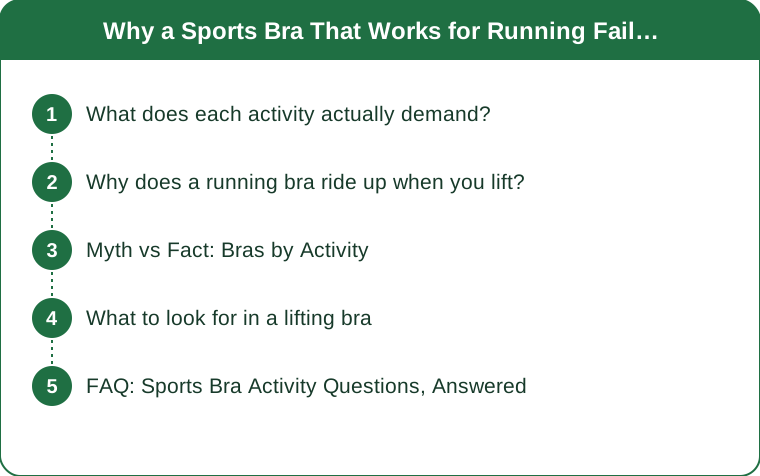
What does each activity actually demand?
Different directions of movement, different loading, and different breathing requirements.
Running is vertical, repetitive and predictable. Breast movement in running is dominantly up-and-down with a figure-of-eight component, at a consistent frequency for thirty minutes or more.
A running bra therefore optimises for high vertical control. Firm wide band, encapsulation or strong compression, minimal stretch through the cup, and straps that resist elongation.
Lifting is low-frequency but high-range and multi-directional. Overhead pressing, rowing, rotation, and deep hinging all move the ribcage and shoulder girdle through ranges running never touches.
Lifting also loads the bra externally. A barbell on the traps, a bag or bar against the chest, straps under a loaded shoulder — none of which happens while running.
Breathing requirements differ sharply. Lifting requires bracing — a deep breath held against a stiff torso — and a very firm band physically restricts the ribcage expansion that brace depends on.
And skin contact points differ. A bra that never touches anything while running gets compressed under a bar, pinched by a strap, or pressed against a bench.
Why does a running bra ride up when you lift?
Because overhead movement pulls the front of the garment upward and there is nothing anchoring it down.
Reaching overhead lifts the ribcage and shortens the front torso, which pulls the band up at the front.
Compression-style bras have nothing to resist that. Without a strong anchoring band with real grip, they migrate a little on each rep and stay migrated.
Racerback designs make it worse for overhead work. Straps that converge at the centre back transmit an upward pull directly to the band whenever you reach up.
Shoulder retraction in rows and pulls has a similar effect from the opposite direction.
Very firm bands are counter-intuitively more prone to this because they cannot deform to accommodate ribcage expansion and so slide instead.
And the band riding up removes almost all of its support, which is why the bra feels both restrictive and unsupportive at once — the classic lifting complaint.

Myth vs Fact: Bras by Activity
Myth: One high-impact bra covers everything. Fact: A high-impact bra is engineered for vertical control. It is frequently the wrong tool for overhead pressing, heavy bracing, and barbell work, where band restriction and strap pressure become the limiting factors.
Myth: Tighter is more supportive. Fact: Support comes from band fit and cup structure, not from constriction. A band tight enough to restrict ribcage expansion actively degrades lifting performance by preventing a proper brace.
Myth: Racerback is always more supportive. Fact: Racerback reduces strap slippage and helps for running, but for overhead work it transmits upward pull to the band and it concentrates pressure at the upper traps — exactly where a barbell sits.
Myth: Underwire is unsuitable for lifting. Fact: A well-fitting underwire can be excellent for lifting because it provides support without needing a punishing band. What it does not tolerate is a poor fit, where it will dig during a bench press or a front rack position.
Myth: Low-impact bras are for low-effort workouts. Fact: Impact rating describes the movement the bra is designed to control, not the difficulty of the session. Heavy lifting is a genuinely hard workout that generates very little vertical breast movement.
Myth: Discomfort under a barbell is unavoidable. Fact: It is a strap-width and strap-placement problem. Wide, padded, straight straps placed away from the bar’s contact point resolve it for most people.
What to look for in a lifting bra
Different features, and often a lower impact rating than people expect.
A supportive but not restrictive band. Firm enough to stay put, with enough stretch to allow full ribcage expansion for bracing. If you cannot take a full deep breath, it is too tight for lifting.
Wide, straight straps rather than racerback for barbell work, positioned so they do not sit under the bar’s contact point on the traps.
Padded straps if you back squat. The bar plus a thin strap plus a shoulder is a genuine pressure point.
Smooth, flat seams across the upper back for anything performed lying on a bench.
Enough coverage that nothing shifts in a front rack or clean position, where the bar contacts the chest directly.
And medium impact is usually right. For most lifting, a medium-impact encapsulation bra outperforms a high-impact compression one on both comfort and function.
For mixed sessions — lifting then a run — prioritise the running. The vertical control requirement is the harder one to meet, and it is easier to tolerate a running bra for twenty minutes of lifting than the reverse.

FAQ: Sports Bra Activity Questions, Answered
Can I use the same sports bra for running and lifting?
You can, but neither will be ideal. Running bras prioritise vertical control with a firm band, which restricts the ribcage expansion that bracing under load requires. Lifting bras prioritise band comfort and strap placement, which is insufficient for sustained running.
Why does my sports bra ride up when I lift overhead?
Because reaching overhead shortens the front of the torso and pulls the band upward, and compression-style and racerback designs have little to resist it. A band with more grip and straight rather than converging straps usually fixes it.
What kind of sports bra is best for weightlifting?
Usually a medium-impact encapsulation style with a supportive but breathable band, wide straight padded straps positioned away from where a barbell sits, and flat seams across the back. If you cannot take a full deep breath in it, it is too tight to brace properly.
TL;DR:
- Running loads a bra vertically and repetitively; lifting loads it through overhead reach, retraction and external pressure from a bar.
- A band tight enough for running can restrict the ribcage expansion that bracing under load depends on.
- For lifting: medium impact, encapsulation, wide straight padded straps, flat back seams, and a band you can breathe deeply in.
- Racerback helps running and hurts overhead work. It is not a universal upgrade.
If your bra feels both restrictive and unsupportive during a lifting session, it is the wrong tool, not the wrong size.
See It in Motion
Seen here: UPF 50+ Racerback Yoga Tank Top — shop it on bubblelime.com
Keep Reading
This article is for general informational and styling purposes only. Fit, sizing, and product availability may vary.