Why Your Sports Bra Fits Differently at 8am Than at 6pm
Quick Answer: Rib cage circumference, breast tissue volume, and fabric recovery all change over a day. Fluid retention shifts measurements by up to an inch, breast tissue swells and softens across the menstrual cycle, and elastic relaxes measurably with body heat and wear time. A bra fitted at 8am on a hook setting that felt right can feel loose by evening — and that’s normal, not a defect.
You bought the size that was measured properly. In the morning it’s perfect. By your evening class the band is riding up and you’re wondering whether you wasted the money.

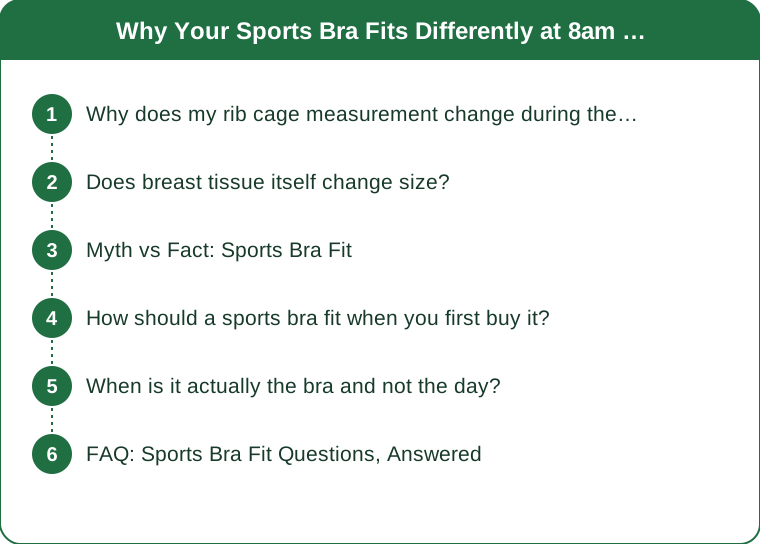
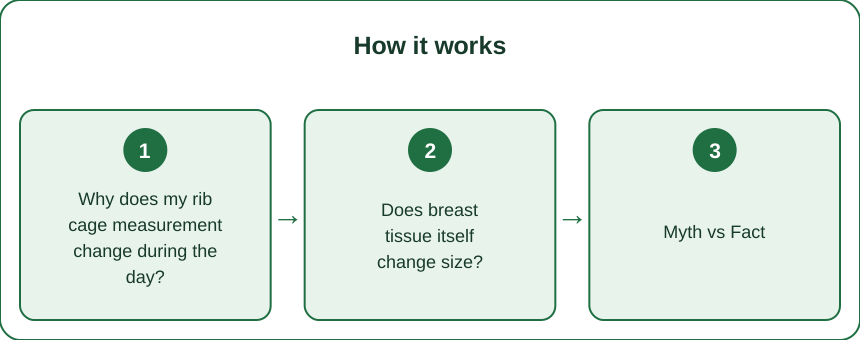
Why does my rib cage measurement change during the day?
Because rib cage circumference isn’t a fixed number.
Fluid distribution shifts. Overnight, lying flat redistributes fluid; upright hours move it downward and outward. Sodium intake, heat, and hormonal phase all add to this. Measured differences of half an inch to a full inch across a day are ordinary.
Breathing pattern changes the measurement. After exercise, resting breathing volume stays elevated for a while and the rib cage sits slightly more expanded. Measure right after a workout and you’ll get a larger number than you would at rest.
Digestion contributes. The lower rib cage sits directly above the stomach, and a full stomach pushes it outward. This is most noticeable on people who measure right at the underbust.
The practical consequence is that band size is a range, not a point, which is exactly why bras come with multiple hook settings. The hooks exist to absorb this variation, not just to accommodate stretch over months.
Does breast tissue itself change size?
Substantially, and on a predictable cycle.
Breast volume varies across the menstrual cycle, typically peaking in the days before menstruation and returning to baseline afterward. Reported changes range widely between individuals, but a full cup size difference is common enough that many people keep two band settings in rotation.
Tissue firmness changes too, not just volume. Premenstrual tissue is denser and less compressible, so a compression-style bra that felt supportive last week can feel restrictive this week at the same size.
Heat matters as well. Warm tissue is softer and compresses more, which is part of why a bra feels different in a hot studio than in an air-conditioned one.
What to do with this: buy for your mid-cycle measurement, use the tightest hook when tissue is softest, and loosen as needed. If a bra only works during one week of the month, it’s the wrong bra — the right one has enough hook range to cover the swing.
Myth vs Fact: Sports Bra Fit
Myth: A tighter band always means more support. Fact: Support comes from band tension distributed evenly, not maximum tension. A band cranked past comfort digs in, rides up at the back, and actually reduces contact area — which reduces support. If the back of the band is arcing upward, it’s too tight or the straps are over-shortened.
Myth: You should buy the same size you wear in a regular bra. Fact: Sports bras are built to different specs. Compression styles run tighter by design; encapsulation styles are closer to regular sizing. Cross-brand variation is larger in sportswear than in lingerie.
Myth: If it stretches out, it was low quality. Fact: All elastic relaxes with body heat and returns partially on cooling. A bra that feels loose after 45 minutes of work and tight again the next morning is behaving normally. Permanent loss of recovery is the actual quality signal, and it shows up over months.
Myth: More straps and hardware mean more support. Fact: For most activity, band tension does the work. Hardware adds adjustability, not support, and adds friction points where chafing starts.
Myth: You should replace a sports bra every six months. Fact: It depends entirely on wash cycles and heat exposure. Roughly 40 to 60 wears with cool washes and air drying, far fewer with hot machine drying.

How should a sports bra fit when you first buy it?
On the loosest hook, and this is the part most people get backwards.
Elastic loses some recovery over the life of the garment. Buying it fitted on the tightest hook means you have nowhere to go when that happens. Starting on the loosest hook gives you two settings of runway.
The fit checks, in order:
Band: horizontal all the way around, two fingers under it with effort not ease, no riding up at the back when you raise your arms.
Straps: carrying maybe 10 to 20 percent of the load. If shoulder marks appear after a session, the band isn’t doing its job and you’ve compensated with the straps.
Cups or panels: no spillage at the top or sides, no gaping at the top edge. Gaping means the cup volume is too large for the tissue at that moment.
Movement test: jump ten times. Motion should be dampened rather than eliminated — total immobilization usually means a band tight enough to restrict breathing.
Do this test at the time of day you actually train. A bra fitted at 11am for a 7pm class was tested under conditions you’ll never train in.
When is it actually the bra and not the day?
There are clear signals that separate normal variation from a worn-out garment.
It’s the day if: fit differs morning to evening but resets overnight, feels different in one week of the month, or feels looser after a hot session and normal the next day.
It’s the bra if: the tightest hook no longer feels like the loosest hook did when new, the band no longer sits horizontal even when adjusted, the fabric shows a visible wave or ripple at rest, or straps slip continuously regardless of adjustment.
The reliable test: lay the bra flat when cool and dry, and compare band length to a newer one in the same size. Elastic that has lost recovery measures visibly longer at rest.
One more variable people miss: washing habits determine most of the lifespan. Heat is the enemy of elastane. Machine drying on high cuts effective life dramatically, and fabric softener coats the fibers and reduces recovery further.
Cool wash, no softener, air dry, and rotate between at least two so each gets a full day to recover between wears. That combination roughly doubles the useful life of the same garment — which is a bigger effect than most upgrades you can buy.
FAQ: Sports Bra Fit Questions, Answered
Should I size down as the bra ages?
No — tighten the hooks instead, which is what they’re for. Sizing down in a new purchase to compensate for anticipated stretch leaves you with a bra that’s too tight for its entire first month.
Why does the band ride up at the back?
Almost always because the band is too loose for the load, or the straps have been shortened to compensate. Straps pulling upward lift the back of the band. Loosen the straps first, then tighten the band, in that order.
Is it bad to sleep in a sports bra?
It isn’t harmful, but it shortens the garment’s life by giving the elastic no recovery time, and constant compression can irritate skin. If you sleep in one for comfort, keep a dedicated soft bra for that rather than using your training bra.
TL;DR:
- Rib cage measurement varies up to an inch across a day from fluid, breathing, and digestion.
- Breast volume and firmness change across the menstrual cycle — hook range exists to absorb both.
- Buy fitted on the loosest hook so you have runway as elastic relaxes.
- Cool wash, no softener, air dry, and rotate two bras to roughly double useful life.
Most of what feels like a fit problem is a timing problem. Fit at the hour you actually train, use the hooks the way they were designed, and judge the bra over months rather than hours.
See It in Motion
Seen here: Racerback Tank Top - White — shop similar styles on bubblelime.com
Keep Reading
This article is for general informational and styling purposes only. Fit, sizing, and product availability may vary.